What SB-2 Base Is and Why Arkansas Drives Are Built on It
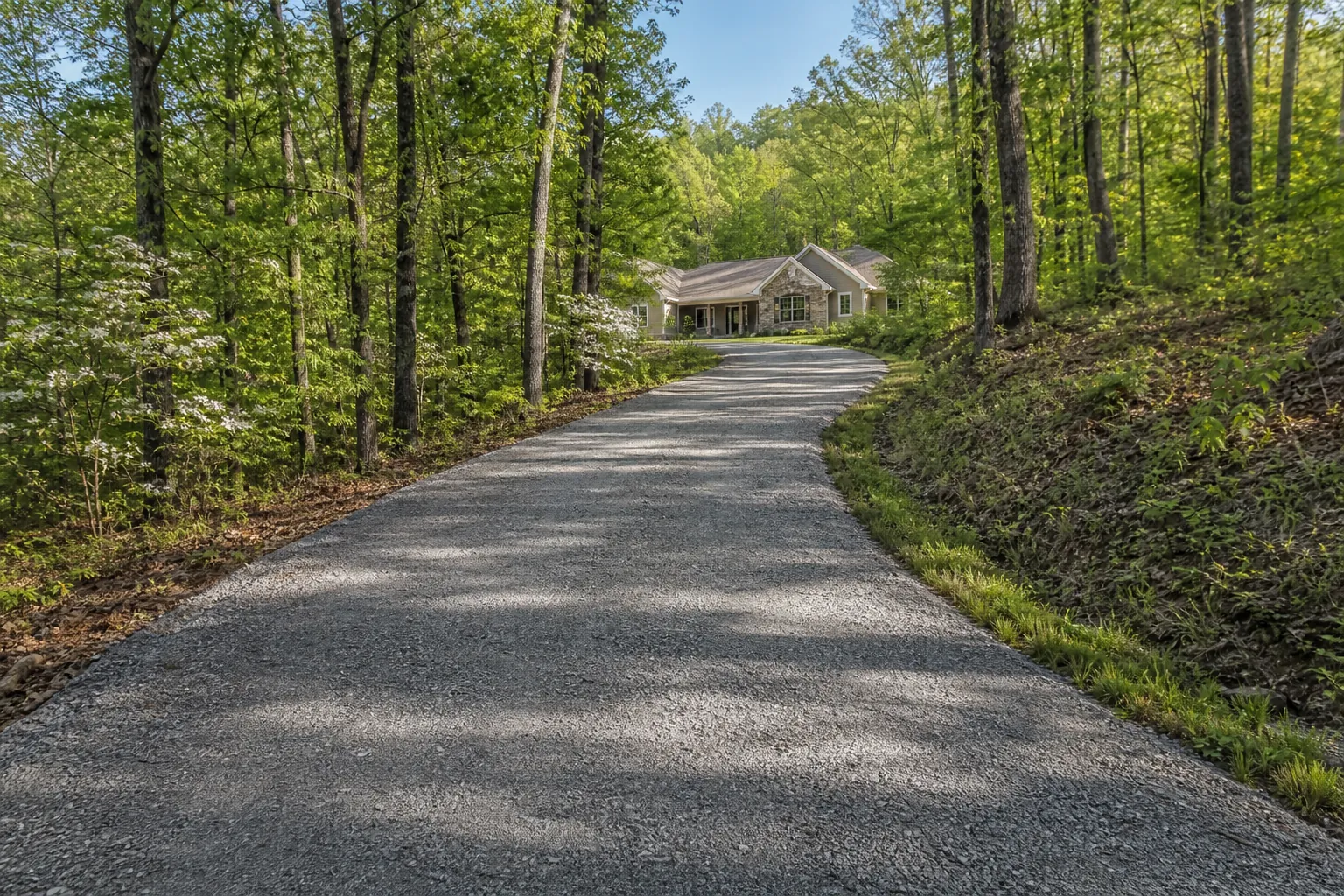
Ask an Arkansas quarry for road base and you may get a question back: do you mean SB-2? Buyers from out of state have usually never heard the name, and two loads sold under it can look nothing alike. The name is older than the state's current spec book, and the rock behind it depends on the quarry.
SB-2 and Class 7: one material, two names
SB-2 is a name carried over from older state specifications. An old City of Conway street ordinance, still posted in the city's archive, required crushed stone base to conform to "Class SB-2 of the State of Arkansas Specifications for Crushed Stone Bases." Gravel bases had a class of their own, GB-2.
The current book uses class numbers instead. ARDOT's Standard Specifications for Highway Construction (2014 edition) covers aggregate base in Section 303 and its Table 303-1, which sets eight gradings, Class 1 through Class 8, and the name SB-2 does not appear there. Classes 7 and 8 are the quarried classes. The section says they must be "any mechanically crushed natural rock or stone" produced "from a solid geological formation by quarrying methods.". Class 7 passes a 1 1/2 inch sieve, and quarries around Little Rock still use the old name. One lists its Class 7 base as SB-2, 1 1/2 inch minus with fines. Another carries a product called SB-2 on its list as well.
Conway, for one, buys it by the class number. The City of Conway's 2016 annual gravel bid estimated about 20,000 tons of Class 7 aggregate base course for its street department and other city departments that year. It required material meeting Section 303, capped Los Angeles abrasion wear at 45 and asked for a California Bearing Ratio of at least 70. So when a plan, a city standard or an engineer says Class 7, the quarry ticket may well say SB-2.
Class 8 is the same idea at a 1 inch top size. Here are the two gradings side by side, from Table 303-1:
Sieve size | Class 7, percent passing | Class 8, percent passing |
1 1/2 inch | 100 | not listed |
1 inch | 60 to 100 | 100 |
3/4 inch | 50 to 90 | 65 to 100 |
No. 4 (about 3/16 inch) | 25 to 55 | 25 to 55 |
No. 40 | 10 to 30 | 10 to 30 |
No. 200 (dust) | 3 to 12 | 3 to 12 |
How the fines make it lock up
Read that table from the bottom. Up to 12 percent of a Class 7 load can be dust fine enough to pass the No. 200 sieve, and a quarter to a little over half of it passes the No. 4. Everything else is stone, up to 1 1/2 inches. Wet that blend and roll it, and the sand and dust pack into the gaps between the big pieces. The layer stops acting like a pile of rock and starts acting like one mat.
The Federal Highway Administration's Gravel Roads Construction and Maintenance Guide puts the principle in plain terms. Gravel is a mix of stone, sand and fines, and without a good blend of the three it performs poorly. No operator can grade bad gravel into good gravel.
ARDOT is just as particular about what the fines are. The part passing the No. 40 sieve must have a plasticity index of 6 or less and a liquid limit no higher than 25, which keeps sticky clay out of the binder. Shale and slate are not counted as stone at all, and together with other deleterious matter they are capped at 5 percent by weight. Shale is one of the common rocks of northwest Arkansas, so that rule is not a formality.
Water is the other half. Section 303 has the contractor keep base "substantially at optimum moisture" through mixing, spreading and rolling, adding water or letting it dry as needed. On the highway each course has to reach 98 percent of maximum laboratory density, and 95 percent on driveways and other areas too narrow for a full-width roller. You will not run a density gauge on your drive. The lesson still carries: dry SB-2 will not pack, and SB-2 rolled so wet that it pumps will not either.
Where SB-2 belongs
Section 303 describes aggregate base as a foundation course for a surface course, for other base courses or for pavement. Off the highway that means driveways, parking pads, shed and building pads, and bedding under pipe. The FHWA guide says base gravel placed under a road should meet a state specification. In Arkansas, that is Section 303.
Keep it out of anything that has to drain. A compacted layer is dense on purpose, and the product page for SB-2 base notes that compaction creates a layer that reduces water infiltration. That is exactly what you want under a drive and exactly wrong around a French drain pipe, in a dry well or behind a retaining wall. Those jobs want washed stone with the fines taken out.
SB-2 also has limits as the top layer. The FHWA guide explains that base gravel is graded for strength and drainage, with a larger top size and very little clay, so used as surface gravel it does not form a crust to hold itself together and gets hard to maintain. On a short, flat drive you may never notice. On a long one, or one with a lot of turning traffic, plan a 2 to 3 inch surface course of crushed driveway gravel, a 3/4 inch graded mix, over the compacted base.
Syenite, limestone and why the color varies
Class 7 is a grading, not a rock type. Section 303 accepts crushed rock "of igneous, sedimentary, and/or metamorphic origin" as long as it meets the gradation, wear and plasticity limits. The rock in a load of SB-2 is whatever the quarry has in the ground. The University of Arkansas's Center for Training Transportation Professionals, in its basic aggregates course for technicians, lists Arkansas aggregates as chert, limestone, dolomite, gravel, syenite and sandstone.
The Arkansas Geological Survey's summary of crushed stone shows how that splits by region. All of the state's dolostone and most of its limestone are in the Ozarks, with limestone crushed in Benton, Independence and Lawrence counties. Sandstone is abundant in the Boston Mountains, the Arkansas Valley and the Ouachitas, and quarries across those highlands crush it for aggregate. Nepheline syenite, an igneous rock, is quarried at Granite Mountain in Pulaski County by several companies.
The Survey describes syenite as light to medium gray and notes that quarrymen recognize "blue granite" and "gray granite" varieties, so a syenite load from around Little Rock can run bluish or gray and need not match a limestone drive. The Survey also credits much of the state's syenite with high strength and weather resistance, and one Little Rock syenite quarry markets its SB-2 as harder, less dusty and less prone to tracking than limestone base. That is a claim about the rock, not the grading. A limestone Class 7 that meets Table 303-1 is still Class 7.
Every load ordered here is filled by an independent local quarry or landscape-supply yard, which means the rock you get depends on the source that serves your address. The Arkansas delivery areas page lists the counties covered. If a new section has to match an existing drive, ask what rock it will be before you order.
SB-2 compared with clean rock and crusher run
Two other materials get mixed up with SB-2.
#57 clean rock, sold here as #57 limestone, is angular crushed stone from 3/16 inch to 1 inch with the dust and fine particles left out. Water runs straight through it, and the product page lists it for French drains, retaining wall backfill and concrete aggregate. It does not lock up the way SB-2 does. Its own product page says it cannot compact as tightly as a material with dust-sized particles, and suggests it below a drive as a drainage course rather than as the only driving surface.
Crusher run, also called dense grade, works on the same principle as SB-2: crushed stone blended with stone dust and fine particles that binds when it is moistened and compacted. On this site it is listed as 3/4 inch minus. The site's road base calculator page draws the line simply: road base uses a larger top stone for load support, and crusher run grades more smoothly, so it suits paver bases and close grading.
SB-2 sits at the heavy end of that family. A drive, a parking pad or a pad that has to carry a loaded truck over Arkansas clay is the job it was graded for. A paver base you screed by hand is easier in the smaller crusher run.
What to ask before ordering
- Which grading is it? Class 7 tops out at 1 1/2 inches and Class 8 at 1 inch. If a city standard or a plan names a class, order to that name.
- What rock is it? Syenite, limestone and sandstone can all be crushed to Class 7, and they do not look alike.
- Will anyone inspect it? Conway asked its suppliers for a current gradation and Los Angeles abrasion test from an independent lab. If an engineer or city inspector will look at your base, ask for a current gradation before the first load.
- How many tons? The SB-2 tonnage calculator takes length, width and compacted depth, uses about 1.5 tons per cubic yard for the conversion, and then allows an extra 10 percent for compaction. A drive 12 feet wide and 60 feet long at 6 inches comes to 360 cubic feet, or 13.3 cubic yards. That is about 20 tons, or 22 with the allowance.
- Where does the pile go? The truck tips the whole load in one pile, so choose the spot before you order. The delivery checklist sets out what the truck needs to reach it.
If you are planning a drive, write SB-2 and Class 7 on the same line of your notes, settle the top size, and get the subgrade firm and shaped before any stone arrives. SB-2 does its job only on ground that can hold it, and no grading can make up for soft clay underneath.